The Mohs Scale: What Jewelry Hardness Actually Means for the Pieces You Wear
Every gemstone has a story. But behind the color, the cut, and the light it throws across a room, there is something more fundamental: how well it holds up to the world. The Mohs scale is the tool that answers that question, and once you understand it, you will never look at a gemstone quite the same way again.
A Scratch Test from 1812
Friedrich Mohs was a German mineralogist with a practical mind. In 1812, he devised a simple but effective system to classify minerals by their resistance to scratching. His method: take two materials and drag one across the other. Whichever leaves a mark is harder. Whichever gets scratched is softer.
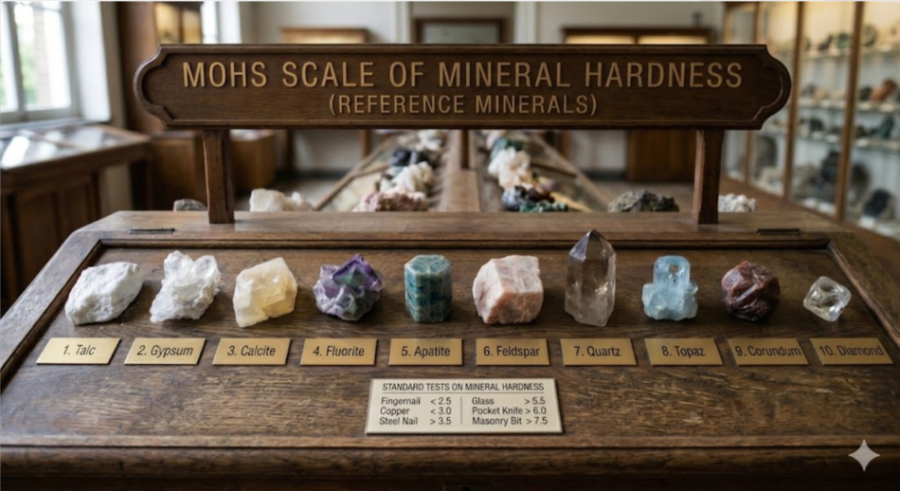
From this, he built a scale of ten reference minerals, numbered from 1 (talc, the softest) to 10 (diamond, the hardest). Every other material falls somewhere along this line.
The Mohs scale is not a linear measurement. The difference in absolute hardness between a 9 and a 10, for instance, is far greater than the gap between a 1 and a 2. It is a relative ranking, not a precise scientific graph. But for practical purposes, especially in jewelry, it tells you almost everything you need to know.
A useful field reference: a fingernail scratches at around 2.5, a copper coin at about 3.5, a steel knife blade at roughly 5.5 to 6.5, and a glass plate at approximately 5.5. Anything that resists a steel blade is already considered hard in practical terms.
The Mohs Scale: From Hardest to Softest
The table below runs from 10 to 1. The reference mineral is the original benchmark Mohs used. The examples column adds the gemstones, metals, and organic materials most relevant to jewelry.
| Mohs Rating | Reference Mineral | Examples in Jewelry |
|---|---|---|
| 10 | Diamond | Diamond |
| 9 | Corundum | Ruby, sapphire, padparadscha |
| 8 | Topaz | Topaz, spinel, aquamarine, alexandrite, morganite |
| 7 | Quartz | Amethyst, citrine, ametrine, rock crystal, rose quartz, tourmaline (7 to 7.5), tanzanite (6.5 to 7) |
| 6 | Feldspar | Opal (5.5 to 6.5), labradorite, moonstone, titanium (6), platinum (4 to 4.5 but surface approx. 4 to 5) |
| 5 | Apatite | Turquoise (5 to 6), lapis lazuli (5 to 6), glass (5 to 5.5), steel (5.5 to 6.5) |
| 4 | Fluorite | Rhodochrosite (3.5 to 4.5), platinum alloys (approx. 4 to 4.5), malachite (3.5 to 4) |
| 3 | Calcite | Gold alloys 18k (approx. 2.5 to 3), silver alloys (approx. 2.5 to 3), coral (3 to 4), copper |
| 2 | Gypsum | Amber (2 to 2.5), pure gold 24k (approx. 2.5), fingernail (approx. 2.5) |
| 1 | Talc | Pearl (2.5 to 4.5), jet (2.5 to 4), ivory (2.5 to 3) |
Note: many materials span a range depending on variety, alloy composition, or internal structure. The values above reflect commonly cited ranges for jewelry-grade materials.
Why It Matters for Jewelry
Hardness determines durability. Not whether a stone will shatter (that is toughness, a different property entirely), but whether its surface will stay pristine over time or slowly dull, chip, and scratch with everyday wear.
Here is the practical consequence: any material in your environment that is harder than your gemstone can scratch it. Quartz dust rates a 7 on the Mohs scale. It is everywhere: in the air, on surfaces, on fabrics. A gemstone below 7 will gradually show micro-abrasions simply through normal use. That is why pieces intended for daily wear need stones that can hold their own.
This is not a reason to avoid softer stones. It is a reason to wear them intelligently.
Gemstones: How They Compare
Diamond (10) is in a category of its own. The hardest natural material known, it resists virtually everything. That said, diamond can still cleave along crystal planes under a sharp blow. Hardness and toughness are not the same thing.
Ruby and sapphire (9) are both corundum, and they are among the most durable gemstones for jewelry. Excellent for rings, bracelets, and anything worn close to friction.
Aquamarine, spinel, and topaz (8) sit in solid territory. Topaz, despite its rating, can cleave if struck at the wrong angle, so protective settings help.
Tourmaline, amethyst, citrine, and other quartz varieties (7 to 7.5) sit right at the everyday threshold. Durable enough for most jewelry, though they will show gradual wear over years of heavy daily use.
Tanzanite (6.5 to 7) is beloved for its extraordinary color but requires thoughtful setting and careful wear. A ring worn daily may not be tanzanite's best context. Earrings or pendants are kinder to the stone.
Opal (5.5 to 6.5) is famously delicate for its hardness rating, and its relatively low toughness adds to that. Absolutely worth wearing, but not in a bezel that traps hard debris against the surface.
Turquoise and lapis lazuli (5 to 6) are porous and soft. Both scratch and absorb chemicals easily. They reward careful storage and limited contact with perfume, cleaning products, and skin oils over time.
Metals: Softer Than You Might Expect
Metals have their own hardness ratings. The picture may surprise you.
- Pure gold (24 karat) rates around 2.5, making it one of the softest metals used in jewelry. It bends and scratches easily, which is why it is rarely used in this form for wearable pieces.
- Gold alloys (18 karat, 14 karat) are harder, typically reaching 2.5 to 3 depending on the alloying metals. Yellow, white, and rose gold have slightly different hardness profiles.
- Sterling silver sits around 2.5 to 3. It scratches readily, which is why silver develops a patina over time. Many people find this patina part of silver's appeal.
- Platinum alloys rate around 4 to 4.5. Harder than gold in comparable alloys and more resistant to wear, but it does develop a surface patina called a matte finish or "platinum patina" over time, which many wearers appreciate.
- Titanium reaches around 6, making it meaningfully harder than precious metals. Used in contemporary and men's jewelry for its lightness and durability.
- Tungsten carbide, used in modern men's bands, sits at 8.5 to 9. It will not scratch in normal use, though it can shatter under sharp impact.
The relatively low hardness of precious metals is not a flaw. It is part of what makes them workable by hand, responsive to engraving, and capable of being shaped into the delicate forms that define fine jewelry. The trade-off is that metal surfaces require care and occasional polishing.
Organic Materials: Beautiful, but Fragile
Organic materials, meaning those derived from living organisms rather than mineral formation, occupy the lower end of the Mohs scale almost without exception. Their appeal lies not in durability but in warmth, rarity, and a quality that is hard to name but immediately felt.
- Pearl (2.5 to 4.5) is among the most delicate materials used in fine jewelry. Pearls scratch easily, lose their luster with contact with acids (including perspiration and perfume), and should be stored separately from harder materials. Wiping with a soft cloth after each wear goes a long way. The rule of thumb: pearls go on last, come off first.
- Amber (2 to 2.5) is fossilized tree resin, ancient and warm in tone. It scratches with a fingernail, is sensitive to solvents and alcohol, and dislikes heat. It is also surprisingly light to wear. Amber is best suited to pieces that see limited mechanical stress: pendants, earrings, brooches.
- Coral (3 to 4) is calcium carbonate of organic origin. It is sensitive to acids and chemicals, and the surfaces can dull or pit over time with careless contact. Red coral in particular has been used in jewelry for centuries and carries significant cultural weight.
- Jet (2.5 to 4) is a form of compacted lignite, a type of coal formed from ancient wood. Deep black and very light, jet was popular in Victorian mourning jewelry. It can be scratched easily and dislikes contact with oils and solvents.
- Ivory (2.5 to 3) is included here for historical completeness. The trade in elephant ivory is now banned internationally under CITES regulations, and antique ivory pieces are subject to strict trade restrictions in many countries. Ivory is sensitive to dryness, temperature changes, and humidity.
The common thread for organic materials: keep them away from chemicals, perfume, heat, and prolonged sun exposure. Store them separately. Do not clean them with ultrasonic or steam cleaners. These materials reward gentle handling and repay the attention handsomely.
Hardness Versus Toughness: The Distinction That Matters
Hardness is resistance to scratching. Toughness is resistance to breaking, chipping, or cracking under impact. They are not the same thing, and confusing them leads to poor choices.
Diamond is the hardest mineral but not the toughest gemstone. Jadeite and nephrite jade, which rate between 6 and 7, are exceptionally tough because of their interlocking crystal structure. A jade bangle can absorb a knock that would chip a diamond. Ruby and sapphire combine high hardness with good toughness, which is a significant part of their lasting appeal in jewelry.
Emerald rates 7.5 to 8 in hardness but has low toughness because of its typical internal fractures. It requires care and respect, not avoidance. Topaz, similarly, has high hardness but a tendency to cleave cleanly under a sharp blow.
How to Use This Knowledge
Understanding the Mohs scale does not mean avoiding softer stones. It means wearing them with intention.
- For rings and bracelets worn daily, aim for stones at 7 or above.
- For earrings, pendants, and brooches worn occasionally, almost the full palette is open to you.
- For organic materials and softer gems, invest in protective settings: bezels over exposed prongs, closed backs where possible.
- Store softer pieces separately from harder ones. A diamond stored loose alongside a pearl necklace will eventually damage it.
- Remove jewelry before cleaning, exercising, or applying products to your skin.
The Mohs scale was devised over two centuries ago with a scratch and a piece of mineral. It remains one of the most useful things a jewelry lover can carry in their mind.
Bizzita covers gemstone properties, quality factors, and materials in depth across its knowledge library. Explore the materials section for detailed guides on individual stones.